

Osteoarthritis is wear and tear of the joint cartilage – and it hurts. The pain is often caused not by the cartilage degeneration itself, but by the accompanying inflammation. This is precisely where gold implantation comes in: it does not attempt to replace the joint, but rather to dampen the inflammatory process within the joint.
During the treatment, tiny pins made of high-purity fine gold are inserted into the connective tissue close to the joints. There, they continuously release small amounts of gold ions. These gold ions influence the cells of the body's immune system that are involved in joint inflammation. We describe how this interaction works in detail in the article Macrophages and gold – how gold ions can relieve pain.
The procedure has its origins in veterinary medicine, where gold implants have been used for osteoarthritis for decades. In humans, it is now used at several European centres.
The placement of the gold implants is carried out under local anaesthesia – a general anaesthetic is not required. You can leave the clinic directly after the procedure. We kindly ask you to bring someone with you; you should avoid driving on the same day due to the local anaesthetic.
Follow-up examinations are generally not necessary, and time-consuming rehab is omitted. The treated joint can immediately be put under normal load again. Physiotherapy, fascial training and massages are easily possible, as are sport and sauna.
Gold implantation is suitable for almost every joint: knee and hip, shoulder, spine, as well as ankle, finger and toe joints. Small joints can also be treated, for which correspondingly finer implants are used. An overview of the individual areas of application can be found on the page Treatment & Procedure, specifically regarding the knee, hip and shoulder in the post Gold implantation for joint pain in knee and hip.
Gold implantation does not work overnight. For most patients, a significant improvement occurs on average after about three months. Some feel relief after just two weeks, while others take considerably longer. Patience is therefore worthwhile—abandoning expectations too early is the most frequent reason for disappointment. There is no guarantee of success: as with other procedures, some of those treated respond hardly or not at all to the therapy.
Should the effect of the gold ions diminish after many years, new implants can be fitted.
Gold is not magnetic. X-rays are unproblematic – the implants appear as small white dots. An MRI is also possible without concern; the implants do not heat up and cannot slip. Airport security checks are not triggered by them either. We answer further questions about the procedure, costs and everyday life in the frequently asked questions about gold therapy.
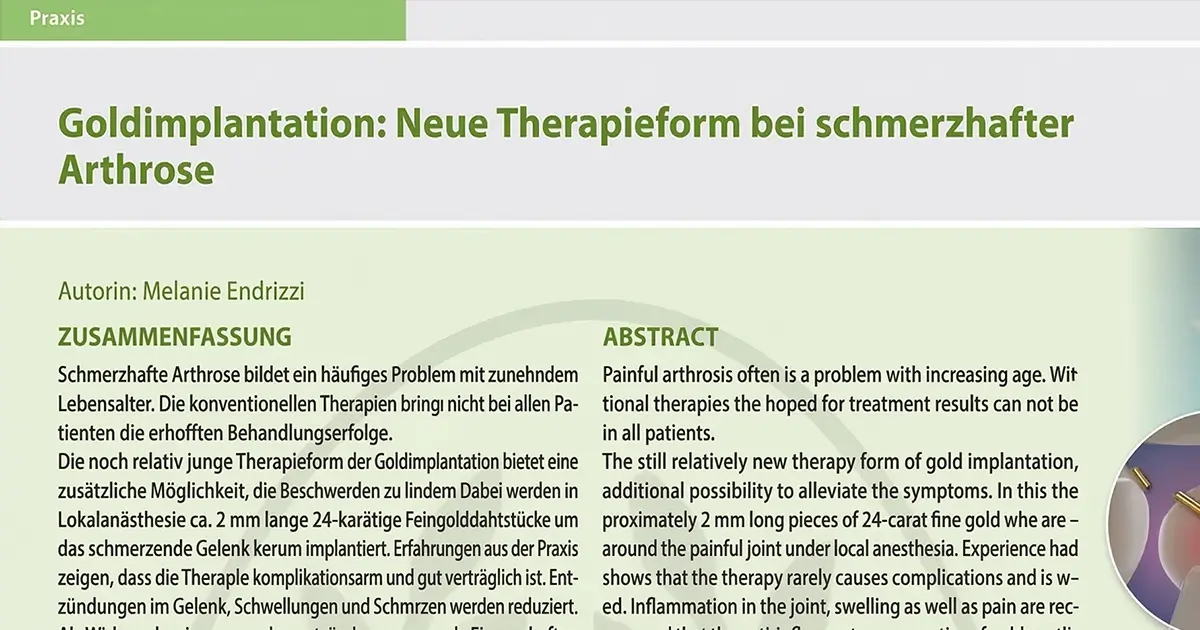
The following expert article from the journal complementary medicine (2021) depicts gold implantation for osteoarthritis in a medical context.
Note: This post is for general information purposes and does not replace a consultation with a doctor. Whether gold implantation is suitable for your condition can only be assessed on an individual basis. Get in touch for an initial consultation.
You are currently viewing placeholder content from Jameda. To access the actual content, click the button below. Please note that doing so will share data with third-party providers.
More Information