

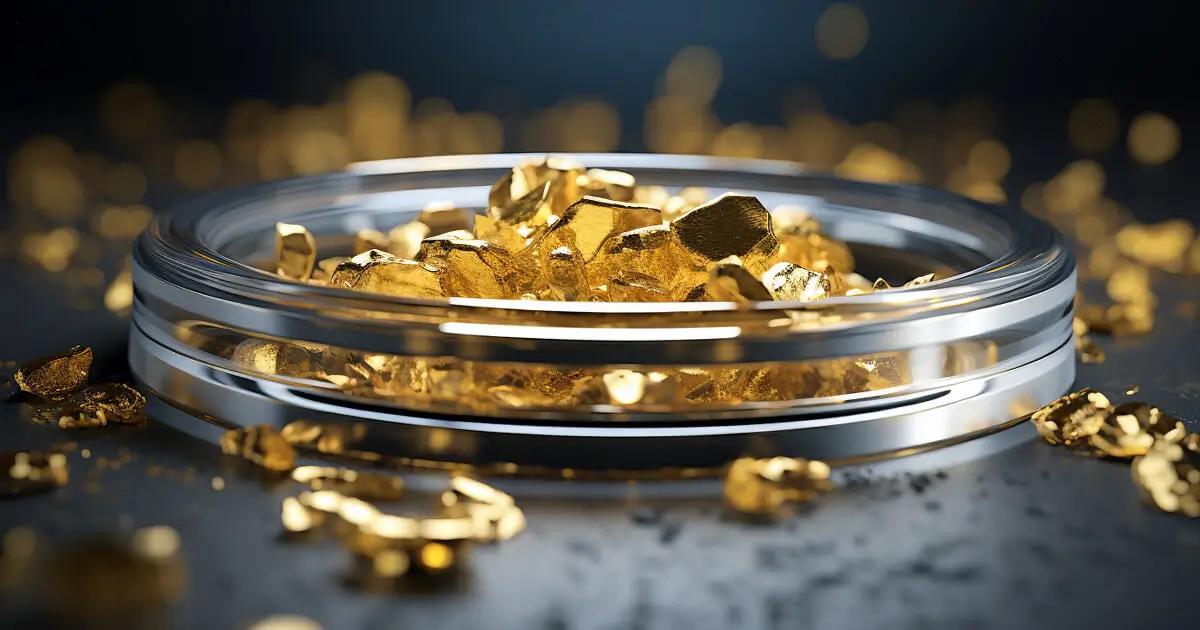
„Aurum metallicum“ - „metal of light“ - is also the name given to gold. This very special precious metal has always fascinated people because of its lustre, purity and rarity. Gold is one of the rarest substances on earth and can only be found and mined in a few places.
In many civilisations, e.g. in the Inca Empire, the wearing of gold in the form of clothing or jewellery was reserved solely for the gods and their earthly liaison - the Inca. Countless wars were fought over the precious metal and even today gold is still considered a relatively stable store of value.
One can only guess why gold was at some point not only regarded as currency, jewellery and a link to the gods, but was also used for medicinal purposes.
Its purity certainly plays a role, as do associations with the divine. Perhaps it was thought that a substance so special had the power to cure illnesses. Whether it was pure coincidence or whether a series of experiments ultimately produced the first successes in the treatment of diseases will probably never be fully known.
What is considered proven, however, is the early use of gold for healing by the Chinese - as early as 2500 BC. The use of gold in medicine was first recorded in writing by the Romans. The wide range of possible applications in combating various diseases and their symptoms is therefore by no means an invention of modern times, but dates back several millennia.
Many studies suggest that gold ions, which are introduced into the body with the help of fine gold rods in gold implantology, for example, are absorbed by the body's defence cells. The ions then unfold their pain-relieving or analgesic effect in the immune cells.
The gold ions also have a positive influence on inflammatory processes in the body; in some cases, inflammation is even completely suppressed. A third possible effect relates to the immune system itself, which is stimulated by the ions and thus promotes gene activity in the tissue.
In principle, gold has some very important properties that make it so valuable for medical use. Its greatest advantage is its low to non-existent tissue reaction, i.e. there are no rejection reactions in the body when cells come into contact with gold. This is what makes the use of gold implants, for example, as well as the use of gold in dentistry, so pleasant and gentle for patients.
Before gold implants were used to relieve joint pain in humans, the method was already successful in veterinary medicine. Following the insertion of gold implants, a significant improvement in mobility was observed and thus also in the general condition of the animal. This led to the conclusion that the treated animals felt less or no pain in the affected joints.
As animals are not able to „fake“ an improvement in their condition or react unconsciously to a possible placebo effect, it could be assumed that the gold implants had a positive effect. In addition, there were virtually no side effects and the treated joints could be loaded normally again immediately after the fine gold pins were inserted.
The Danish physician Dr Hans Kierkegaard was one of the first human physicians to adopt this procedure from veterinary medicine in 1996 and apply it to human patients. Initially, the gold implants were placed at specific acupuncture points, which is why they were also referred to as gold acupuncture.
Since then, Kierkegaard has continuously improved and adapted the procedure, and the gold pins are now placed around the affected, painful joint. Using this method, Kirkegaard has already relieved over 9,000 patients of their joint pain or significantly alleviated their pain (as of 2017).
Dr Endrizzi's interest in gold therapy was sparked by a personal experience when she herself experienced the resounding effect of gold implants after an accident. After qualifying as a specialist in surgery in 1995, she completed specialist training in gold implantation with Dr Kjerkegaard in Denmark in 2014 and opened Germany's first centre for gold implantation according to Dr Kjerkegaard® in 2015. Today, she runs three practices (Düsseldorf, Berlin-Mitte and Constance) and has already successfully relieved over 750 patients of joint pain.
Gold implants can be used to alleviate a wide range of complaints in the knee, shoulder, hip, cervical spine, ankle or wrist, and many patients are even completely pain-free after around three months. In principle, any joint affected by osteoarthritis can be treated, even the smallest joints. This gentle, side-effect-free method is also suitable for spinal or joint injuries, herniated discs and migraines caused by changes in the cervical spine.
The gold implants are inserted on an outpatient basis under local anaesthetic; no antibiotics, rehabilitation or other follow-up treatment is required. The treated joint can be loaded normally again immediately after implantation. There is also no risk of the gold pins „migrating“ in the body. As no general anaesthetic is used, gold therapy is also suitable for people who are not eligible for conventional surgery for medical reasons.
No side effects, no time-consuming follow-up treatment, but a fast, gentle and significant improvement in joint pain until the patient is completely pain-free - all this makes gold implantation an ideal alternative to joint replacement or the long-term use of painkillers.
Arrange a consultation with Dr Endrizzi now and regain your zest for life, mobility and a life without pain!